Cybersecurity Specialist

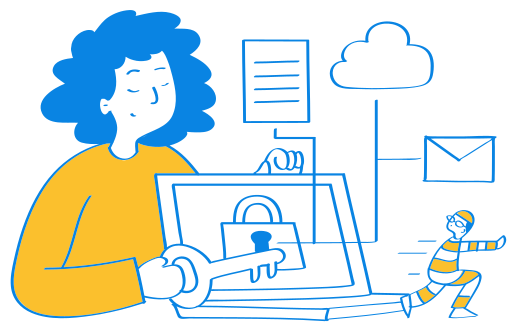
A cybersecurity specialist protects data, websites and networks from being hacked. They think like an attacker to find a weak spot before the bad guys do, and then fix it. If you are curious about how computers and the internet work from the inside and you enjoy solving puzzles, this could be your career.

Cybersecurity Specialist

Today almost everything is stored digitally: bank accounts, medical records, messages, school and government data. That is why people who protect this data are needed everywhere. The job means learning all the time, because new threats and tools keep appearing. Honesty matters too: an ethical hacker uses their skills only legally and with the system owner's permission.

What the job involves

  • Tests systems and websites for vulnerabilities
  • Monitors the network for suspicious activity
  • Sets up protection such as firewalls, antivirus and access rights
  • Investigates incidents and cleans up after attacks
  • Teaches staff the rules of digital safety

Skills you need

  • Networks and operating systems

    Understanding how computers exchange data and where they are vulnerable.

  • Programming

    Reading and writing code, for example in Python, to automate tasks and analyse data.

  • Attention to detail

    An attack is often revealed by a single odd line in a log file.

  • Self-learning

    Technology changes fast, so you keep learning throughout your career.

  • Responsibility and ethics

    Access to other people's data requires honesty and respect for the law.

Who it suits

Personality types

Strong intelligences

  • Logical-mathematical
  • Intrapersonal

UNT subjects to take

State grants 2026

Main competition, full-time study. Quotas and separate state orders can have lower scores. Check your chances

Where to study

Kazakhstan has 4-year bachelor's programmes in Information Security. They are offered, for example, at Astana IT University, International Information Technology University (IITU) and L.N. Gumilyov Eurasian National University. For IT programmes the UNT profile subjects are maths and informatics. Students learn networking, cryptography and how to protect operating systems.

After grade 9 you can enter a college to study IT for 3-4 years and then continue at university. Many people build their skills through practice: CTF competitions, online courses and international certificates. At school it helps to learn programming and English and to try informatics olympiads.

Outlook

In Kazakhstan, cybersecurity specialists work in banks, telecom operators, IT companies, government agencies and large industrial companies. The more services move online, the more important it is to protect them, so organisations need people who can prevent attacks and respond quickly. Remote work for foreign companies is also possible.

Frequently asked questions

Which UNT subjects do I need to study cybersecurity?

For IT programmes, including information security, the profile pair is maths and informatics. Solid maths preparation is especially important.

Is it the same as being a hacker?

A cybersecurity specialist uses the same knowledge as a hacker but acts legally, with the system owner's permission and to protect it. Breaking into other people's systems without permission is a crime.

Can I start learning cybersecurity at school?

Yes. Start with programming basics and how networks work, then try school CTF competitions and free online courses. Practise only on training platforms built for this purpose.

Is this career right for you?

Take the MBTI and Gardner tests: the report shows which directions fit you personally.

Take the free test